


Exhibition Image and information. (Courtesy of Tina Keng Gallery)
A Blast of Lyricism: Contemporary Taiwanese Art in London
抒情 · 暴:倫敦當代臺灣藝術展
Chia-Ling Yang 楊佳玲
Professor, School of History of Art, University of Edinburgh
Lyricism in art and literature has long served as a vehicle for expressing both personal and collective experiences. From poetic reflections on objects that express personal ideals to landscapes which celebrate nature and the desire for seclusion, each theme offers a unique perspective on life. The longing for native land evokes the hardships of duty and exile, while farewell and remembrance express the sorrow of separation and loss. Elegies for the past and reflections on bygone times engage with nostalgia and historical consciousness, whereas self-reflective lamentations reveal personal grief and introspection. Artists interpret space and transform it into form, rendering new images through inner transformation. These traces of intent, both visible and invisible, translate one occurrence into an unrelated outcome. As David Der-wei Wang noted, “lyricism” extends beyond poetry to encompass narrative, film, painting, and calligraphy, shaping both form and feeling. Lyricism is a counterpart to revolution and enlightenment.1
In Taiwan, lyricism has moved from a modernist import to a mode of critical, placebased expression. Postwar artists, many trained abroad, first absorbed Western lyrical abstraction and Abstract Expressionism, fusing their colour theories and gestural vocabularies with ink traditions and East Asian atmospheres. By the 1980s-90s, this formal sensibility began to address political history and collective memory, inflecting poetic brushwork with the weight of martial law, rural transformation, and questions of identity. In contemporary practice, lyricism no longer serves as mere romantic sentiment but as a space for material experimentation, sensory engagement, and the dismantling of inherited aesthetic authority.
Featuring artists Chen Chun-Hao 陳浚豪(b. 1971), Chiang Yomei 蔣友梅(b. 1961), Chiu Chen-Hung 邱承宏(b. 1983), He Yusen 何宇森(b. 1995), Ava Hsueh 薛保瑕(b. 1956), Lee Jo-Mei 李若玫(b. 1985), Su Meng-Hung 蘇孟鴻(b. 1976), Yang Chung-Ming 楊忠銘(b. 1974) and Yao Jui-Chung 姚瑞中(b. 1969), this exhibition explores how this enduring tradition of lyricism continues to evolve and influence contemporary creative practices. How does lyricism unfold through the interplay between native traditions and external stimuli in contemporary Taiwanese art? How does emotional depth take shape as an aesthetic of evocation, resonance, and poetic suggestion through material expressiveness? How can fragmented narratives reveal diverse ideals and realities across multiple media?
The exhibition is organised into four thematic sections: Post-Republican Pseudo-Landscape(後民國偽山水), Secret Realm of Things(物的秘境), Temperature of Feeling(情的溫度), and All Conditioned Phenomena(有為法); each unveiling distinct facets of lyrical themes in collective history and personal expressions through diverse mediums and conceptual approaches.
By adopting, subverting, or expanding classical aesthetics, the artworks in Post-Republican Pseudo-Landscape challenge conventional “ink art” and landscape representations, concerning the reinterpretation of Sinophone traditions with contemporary sensibilities. Secret Realm of Things explores the intersection of poetics and materiality, examining how artists experiment with everyday objects and seemingly organic forms to convey memory and the unspoken connections between things and human experience. Temperature of Feeling moves beyond conventional storytelling, embracing disrupted narratives and open-ended compositions. Through fractured imagery and abstracted forms, the works reflect on cultural translation and indigenous identities in Taiwan. The final section, All Conditioned Phenomena, contemplates the cyclical nature of time. Through meditative compositions, the works embody continuous transformation, offering a poetic inquiry into the fluidity of being.
Secret Realm of Things
The exploration of objects in art is often an attempt to tap into the most primal, intimate aspects of existence, those inner fluctuations that reflect the innocence and vulnerability of a childlike heart. In the second gallery, this search in the Secret Realm of Things, however, is not about objects in a literal sense, but rather about what they evoke: the memories, sensations, and fleeting emotions that lie dormant within them. In the works of artists Lee Jo-Mei, Yang Chung-Ming, Chiu Chen-Hung, and Chiang Yomei, objects are more than just physical forms; they serve as conduits for an exploration into the uncharted depths of the psyche, an attempt to access the secret realms of inner life.
Drawing on the ideas of French phenomenologist Gaston Bachelard in The Poetics of Space (1958), where he writes, “We comfort ourselves by reliving memories of protection. Something closed must retain our memories while leaving them their original value as images.”2 Bachelard suggests that these closed, secure spaces offer comfort precisely because they provide a sense of containment and safety. They hold our memories as though they were physical objects, encapsulated in space, preserved in their original form. The act of returning to these memories is not one of distortion or alteration but of protection, preserving the authenticity of the emotions and experiences that are tied to those memories. This reflection on the role of memory in shaping our inner landscapes parallels the artworks’ exploration of how past experiences and memories contribute to the creation of expansive, dream-like realms. The artworks in this gallery resonate with this philosophical inquiry. Yang and Chiang engage with the fleeting, indistinct nature of reality, embracing its ephemeral qualities to expand the boundaries of perception. Rather than anchoring their practice in the material world alone, they reflect an interest in what lies beyond the visible, a boundless space where the limits of a relative viewpoint dissolve.
Similarly engaged with perception, memory, and material transformation, Yang Chung-Ming is a pioneering figure in contemporary printmaking. Notably, he is the only printmaker of his generation whose works are included in the esteemed collection of the National Palace Museum in Taipei, underscoring his distinctive contribution to the field. His approach challenges traditional boundaries by merging the ancient craft of papermaking with innovative explorations of paper’s fibre structure and its plantbased origins. What sets his work apart is his use of light rather than ink to reveal images, allowing his prints to emerge and shift as light interacts with the materials, offering a subtle, ethereal quality that redefines what printmaking can be.
From a young age, Yang has devoted himself to mastering the mezzotint technique, skilfully revealing delicate and rich gradations of grey within deep, velvet-like blacks, reminiscent of silver pebbles slowly emerging in the dark. His series of works typically begins with textual discourse before moving into creation, which he describes as “landscapes born from words.” Beyond mezzotint, Yang’s engagement with printmaking extends deeply into handmade paper and watermark techniques. Since collaborating with the Taiwan Forestry Research Institute in 2019, he has explored layering multiple single-print watermarks on untreated white paper. When illuminated, the overlapping watermarks and paper fibres emerge as subtle, nuanced patterns. Using this method, Yang Flora of Formosa series reinterprets the botanical illustrations of Japanese botanist Iwasaki Tsunemasa’s(岩崎常正, 1786-1842)Honzō zufu 本草図譜 (Supplement to the Compendium of Materia Medica).3 The frames for these works are crafted from old specimen wood collected from the Forestry Research Institute, underscoring the intersection of scientific and artistic inquiry into plants.
Yang’s philosophy that “the medium serves the theme of creation” underpins much of his work. His work incorporates linocut, handmade paper with natural dye, watermark, plant materials, glass, mezzotint, and chine-collé, as well as the use of burned books. The tactile richness of his materials, from the fibrous handmade paper to the delicate imprints of plant life, enhances the visual impact, arousing a sense of organic growth, decay, and renewal.

YANG Chung-Ming, Flora of Formosa : Chapter 3 of Moonlight 無華之境系列 : 鏡月卷之三
2023. Watermark, and handmade paper, 81 × 54 cm.

YANG Chung-Ming, Flora of Formosa: Chapter 3 of Moonlight (detail) 無華之境系列 : 鏡月卷之三 (細部)
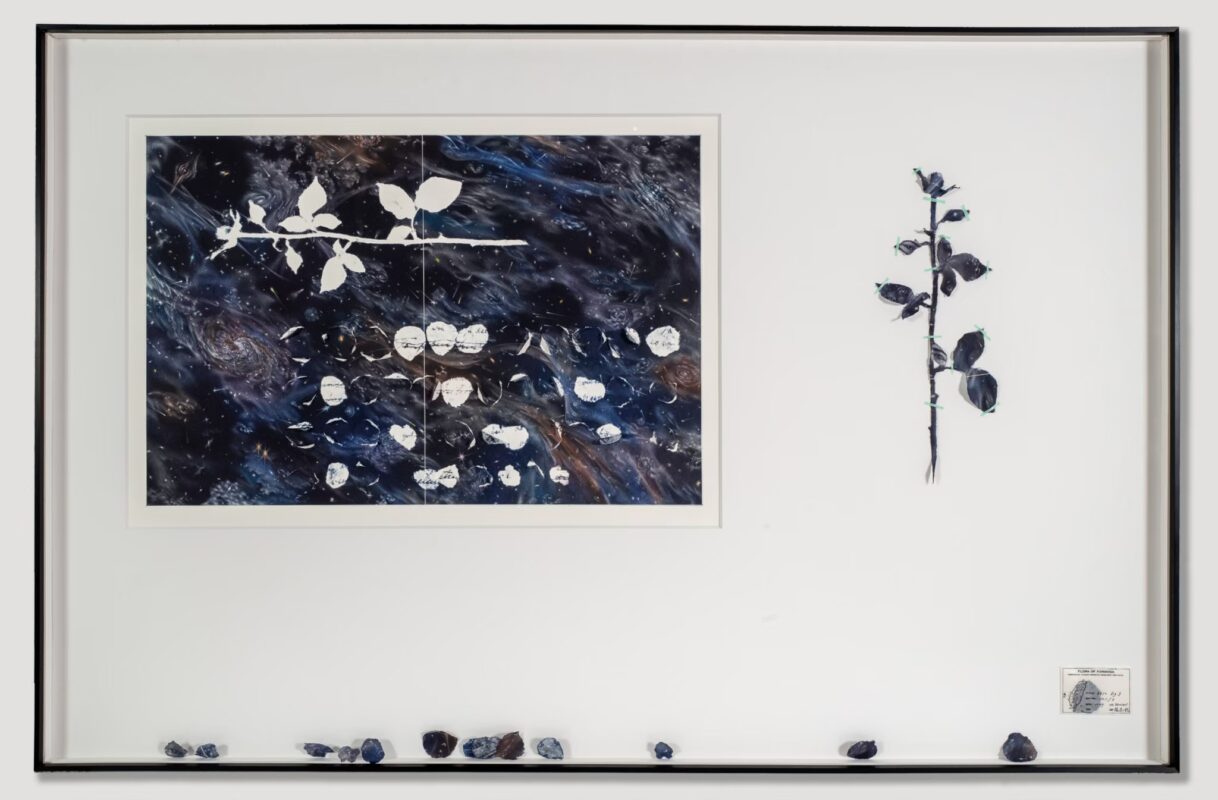
YANG Chung-Ming, Flora of Formosa: B612 fig. 3 無華之境系列: B612 fig. 3
2024. Mezzotint, watermark, handmade paper, and chine collé, 120 × 78 × 3 cm.

YANG Chung-Ming, Flora of Formosa: Unspeakable Shadow 無華之境系列:落墨不成章
2024. Watermark, handmade paper, and natural dye, 220 × 145 cm.
A defining characteristic of Yang’s prints is the interplay between light and material. Rather than relying on traditional ink, his works reveal images through the shifting interaction of light with the paper’s translucency. This creates an almost spectral presence, luring viewers to experience the gradual unveiling of form as light moves across the surface. The translucency of the paper becomes a metaphor for latent knowledge and the unseen labour involved in preservation. Yang collapses the reproducibility of printmaking into a singular moment, echoing Walter Benjamin’s notion of the “aura” in the age of mechanical reproduction: here, multiplicity becomes the site of temporal condensation rather than dissipation.4
All Conditioned Phenomena
The final gallery, All Conditioned Phenomena, conveys a poignant, lyrical meditation on the cycles of existence, life, death, decay, and rebirth, through works by Chiang Yomei, Su Meng-Hung, Yang Chung-Ming, and Ava Hsueh. Each artist engages with the impermanence of the material world, exploring the interplay between form and dissolution while challenging the illusion of permanence.
In Flora of Formosa: Unspoken Chapter(無華之境系列:碎句不語)(2024), Yang Chung-Ming constructs a delicate and haunting meditation on transience, memory, and the afterlives of both literature and material. Bringing together poetics, natural history, and archival remains, the series centres on the image of the butterfly, at once fragile, ephemeral, and culturally saturated, transformed into a vessel for literary and ontological reflection. Collaborating with the Taiwan Forestry Research Institute, Yang employs a traditional watermark papermaking technique, incorporating elements from brittle antique volumes and botanical dyes to create each black-and-white paper butterfly. Mounted with fine entomological pins used in specimen preservation, the butterflies exist in a suspended state, between life and artefact, flight and stillness, presence and erasure. The fragmentary quality of the series is signalled in its subtitle, “Unspoken Chapter”(碎句不語), a phrase inspired by Chou Meng-Tieh’s 周夢蝶 (1921-2014) poem Days of Accumulated Rain( 積雨的日子). In this poem, Chou uses the imagery of continuous rainfall to express a sense of resignation toward life’s circumstances and the inescapability of fate. As Yang noted, “Chou entrusted his regrets to falling leaves; I entrust my remembrance of poetic imagery to the paper. His sigh was about what was missed; mine is a retranslation of that feeling, offered to the viewer.” (周公寄遺憾之情於落葉、我則寄懷想詩中情境於紙頁。周公喟嘆於錯過的感受,我則將感受重譯後獻給觀眾。)This personal act of translation culminated in a silent pilgrimage, on a cool, rainy autumn day, Yang walked to Taipei’s Guling Street(牯嶺街), the very location described in Chou’s verse. This engagement with poetic time also manifests materially through Yang’s collaboration with Songlin Bookstore( 松林書局), one of the oldest surviving bookshops from the once-thriving Guling Street second-hand book market, which at its height hosted over 200 stores. Songlin, established in 1945, suffered a fire decades ago, leaving many books charred and water-damaged. Rather than discarding them, the owner left the damaged volumes piled outside, their burnt edges still bearing witness to the event.5 Yang incorporates these scorched books into the work, drawing on their physical wounds to respond to the poem’s evocation of loss and endurance. In Flora of Formosa: Unspoken Chapter, butterflies emerge from ash and absence, suggesting a kind of quiet resurrection. Across the series, the economy of form, its visual restraint, translucent layering, and fragmentary text mirror the aesthetic of the poems it responds to. The work does not seek to narrate or explain, but rather to hold space for reverie, impermanence, and the shared solitude that art, at its most generous, allows.
Yang’s invocation of solitude, “art begins in one’s own loneliness and moves toward a shared intersection,” aligns with Emmanuel Levinas’s ethical philosophy, where the self emerges not in isolation but in encounter.6 The butterfly, then, becomes a symbol of both the self’s fragility and its potential for communion, suspended in a space that resists nation, category, and noise. In this realm, the poem does not speak but listens.

YANG Chung-Ming, Flora of Formosa: Unspoken Chapter II 無華之境系列: 碎句不語之二
2024. Watermark, handmade paper, natural dye, and burned book, 44 × 32 × 20 cm.

YANG Chung-Ming, Flora of Formosa: Unspoken Chapter II (detail) 無華之境系列: 碎句不語之二(細部)
This final gallery, where endings fold seamlessly into new beginnings, embodies the artists’ contemplative engagement with the fleeting nature of all things. For them, art becomes a vessel for attuning to the ceaseless flow of existence. The cycles of life are not distant abstractions but lived realities, in which creation and dissolution intertwine, each giving rise to the other in an unbroken, continuous rhythm.
Change, contradiction, and destruction are central to life’s development; life cannot remain stagnant, as stasis equates to near death. Transformations, whether through words, images, or sound, seek to capture a particular moment of life, freezing it while allowing it to persist across time and space. These moments become “alternative existences,” enduring the passage of time and transcending the constraints of their original context. This is where the true value of literature and art lies.
Lyricism in art captures the delicate tension between stasis and flux, offering a way to register fleeting moments while remaining sensitive to deeper emotional and material currents. This exhibition unfolds across four thematic constellations: Post-Republican Pseudo-Landscape, Temperature of Feeling, Secret Realm of Things, and All Conditioned Phenomena, each tracing a distinct pathway through which lyricism takes shape. From fractured landscapes that register contested histories, to sensory abstractions that suggest emotional undercurrents, and from the quiet agency of objects to reflections on impermanence, the works assembled here channel lyricism as both form and affect. These constellations open up a space in which memory and sensation, material and metaphor intersect, offering new ways to approach the subtleties and complexities of contemporary Taiwanese art.
Annotation
- David Der-wei Wang. The Lyrical in Epic Time: Modern Chinese Intellectuals and Artists Through the 1949 Crisis (Columbia University Press, 2015), 1-38. ↩︎
- Gaston Bachelard. The Poetics of Space (Boston: Beacon, 1994), 6. ↩︎
- Iwasaki Tsunemasa 岩崎常正. Honzō zufu 本草図譜 (Supplement to the Compendium of Materia Medica) (Tokyo: Tsuruta Seiji 東京市: 鶴田淸次, 1884). ↩︎
- Walter Benjamin. The Work of Art in the Age of Mechanical Reproduction, trans. Harry Zohn (New York: Schocken Books, 1969), 3-28. ↩︎
- Danqing 丹青. “A Walk Through Cities and Villages: Songlin Bookstore’s Rebirth from the Ashes”(走讀城鄉:松林書局 浴火重生). The Merit Times 人間福報, 19 May 2021 (https://www.merittimes.com/news/344749, accessed on 12 August 2025) ↩︎
- Emmanuel Levinas. Totality and Infinity: An Essay on Exteriority, trans. Alphonso Lingis (Pittsburgh: Duquesne University Press, 1969), 39-42. ↩︎
Exhibition site: A Blast of Lyricism: Contemporary Taiwanese Art in London
Know more about artist YANG Chung-Ming
|Source|
Publication | A Blast of Lyricism: Contemporary Taiwanese Art in London
Text | Professor Chia-Ling Yang 楊佳玲 教授
Publisher | Tina Keng Gallery
Images | Gallery de sol

 中文
中文